The Secrets Behind Smooth Sailing in Pond Life
Is your pond water suddenly cloudy, like the Catawba River after a heavy summer storm, or are your koi acting sluggish? Have you noticed fish gasping at the surface or hiding at the bottom?
In this post, you’ll learn how to recognize the signs of a pond water pH imbalance, what causes it, and the exact steps you can take to bring levels back into balance.
By the end, you’ll know how to keep your pond water stable so your fish stay healthy, your plants thrive, and your backyard retreat stays as relaxing as a fall afternoon in the Blue Ridge Mountains.
How Do I Handle Pond Water pH Imbalances?
Handle pond water pH imbalances by first testing with a reliable kit. Maintain pH between 6.5 and 8.5 to avoid stress on aquatic life. Correct imbalances with partial water changes, crushed limestone, coral, or peat moss. Gradually adjust pH to prevent shock and support a stable ecosystem.
Recognizing pH Imbalance Symptoms
Signs of Low Pond Water pH
- Rapid gill movement.
- Lethargy or sluggish behavior.
- Excess mucus production.
- Fish appearing stressed or weakened.
- In severe cases, fish deaths occur due to acidosis.
Signs of High Pond Water pH
- Fish gasping at the surface.
- Fish are hiding at the bottom.
- Isolation from other pond inhabitants.
- Unusual or erratic swimming behavior.
- Visible signs of stress, such as lack of feeding or reduced activity.
- Prolonged exposure leading to fish deaths.
Emergency Fixes for Dangerous Pond pH Levels
Using Alum for High pH
When high pH threatens pond ecosystems, alum can be applied as a quick corrective step.
When used properly, alum improves water quality by binding phosphorus, clearing cloudy water, and helping reduce algae blooms, all of which stabilize the pond’s pH.
A starting dose of about 10 milligrams per liter, or around 27 pounds per acre-foot of water, helps lower pH quickly.
Additional treatments in 5 to 10 milligram increments may be needed if pH levels remain elevated.
This treatment is most effective in ponds with adequate alkalinity because alum can drive the pH too low if the buffering capacity is weak.
Baking Soda for Low Pond Water pH Levels
If acidic water is the issue, baking soda offers a safe and affordable way to bring pH levels back up.
The guideline is about one teaspoon dissolved per gallon for every eight gallons of pond water treated.
This steady addition helps prevent sudden changes in the pond’s pH and naturally caps at a level around 8.3.
Baking soda works well because it creates a simple buffer system, giving the pond greater buffering capacity against pH fluctuations.
For pond owners facing urgent acidic conditions, this method helps restore balance while also protecting pond organisms from further stress.
Safe Long-Term Methods to Raise the pH of Pond Water
Crushed Coral or Limestone
For ponds prone to acidic water, crushed coral or crushed limestone can be added to a pond filter or directly into the water as a slow-release buffer.
These natural materials dissolve gradually, raising pH levels while also increasing hardness and alkalinity.
Because they work over time, they maintain a more stable pH instead of quick jumps that could harm fish or aquatic plants.
This makes them a great option for long-term pond management and for maintaining a healthy pond ecosystem where pH scale ranges remain consistent.
Aeration
Aeration is another effective way to bring up the pond’s pH.
Proper aeration reduces carbon dioxide in the water, which otherwise reacts with water to form carbonic acid. By lowering carbon dioxide levels, aeration gently raises pH and also improves oxygen levels that benefit fish and other pond organisms.
Installing a fountain or an air pump can make a big difference in water quality, fish health, and overall pond life, much like how the historic Blowing Rock Festival brings new energy to the community each year.
Aeration also helps prevent cloudy water caused by organic waste settling at the bottom, creating a cleaner and more balanced ecosystem.
Safe Long-Term Methods to Lower the pH of Pond Water
Partial Water Changes
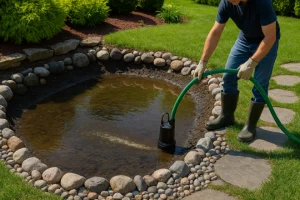
Performing partial water changes with neutral or slightly acidic tap water helps dilute high pH levels.
The key is to treat the tap water with a conditioner to remove chlorine and to match its temperature to the pond before adding it. This avoids shocking fish and aquatic organisms while still lowering pH.
Partial water changes also improve water clarity and reduce nutrients that contribute to algae blooms.
Over time, this method encourages a more balanced ecosystem with fewer pH fluctuations.
Peat Moss
Adding peat moss to a pond filter or directly to the water is a natural way to lower pH.
Peat moss slowly releases tannic acid, which softens water and brings pH levels closer to the ideal range.
It also colors the water slightly, creating a natural shade that can reduce algae growth.
KH Adjustment
Carbonate hardness, or KH levels, play a crucial role in keeping the pond’s pH level stable.
The ideal range for KH is between 125 and 200 parts per million.
If KH is too high, it locks the pond into high pH levels.
Adjusting KH downward with fresh water, peat moss, or other natural methods can gently lower the pH.
Maintaining the right KH levels helps create a buffer system that keeps sudden changes from affecting pond ecosystems.
Algae Control
Excessive algae growth is one of the main factors that affects pH.
During the day, algae consume carbon dioxide and drive the pH up, then release it at night, creating large pH fluctuations.
Removing algae mats by hand, installing a UV clarifier, or using safe pond dyes can reduce algae blooms and prevent high pH levels.
Better water clarity and more stable pH benefit fish, aquatic plants, and all pond inhabitants.
Pond Water pH Imbalance Prevention and Maintenance Practices
The best way to manage ph is through prevention.
Regular testing of pond water for pH, KH, and hardness makes it easier to catch issues before they escalate. Consistently monitoring water quality also ensures that pond ecosystems remain healthy and resilient.
Adding organic matter like straw or compost in small amounts, around 15 pounds per acre per day, but no more than 50 pounds total, can help by increasing carbon dioxide levels and reducing extreme rises in pH.
Auto-dosing systems can also be installed to maintain steady conditions.
Keeping an eye on fish waste, uneaten food, and organic waste helps reduce stress on pond inhabitants.
Avoid overstocking fish.
Be cautious with new limestone or concrete around the pond that may raise pH.
With proper aeration, regular monitoring, and smart maintenance, pond owners can keep pH levels steady and maintain a healthy pond ecosystem where water clarity, fish health, and plant growth remain at their best, echoing the natural balance found in Asheville’s Botanical Gardens.
What does professional koi pond maintenance cost?
Balancing Hardness and Alkalinity in Pond Water
The relationship between hardness and pond water alkalinity determines how easily the pond’s pH can shift.
When alkalinity is much higher than hardness, high pH is more likely to occur.
Balancing these two factors restores the buffering capacity needed for a stable pH. For example, if hardness measures 30 milligrams per liter as calcium carbonate and alkalinity measures 90, gypsum may be added to bring them closer together.
In a two-acre pond about four feet deep, around 2,500 pounds of gypsum would be required.
By improving this balance, pond owners strengthen the pond’s natural defenses against pH fluctuations and help maintain water quality for fish and aquatic organisms.
Stable Waters Ahead with Morganton Ponds & Hardscapes by Your Side
At Morganton Ponds & Hardscapes, we understand that pond water stability is essential for fish health and a healthy pond ecosystem. Our pond maintenance and pond building services are designed to help you avoid pH fluctuations while keeping your pond clear and thriving.
If your pond’s pH level is out of balance, our team has the tools and expertise to bring it back into the ideal range. Fill out our contact form today or give us a call to get your pond on the path to long-term stability.